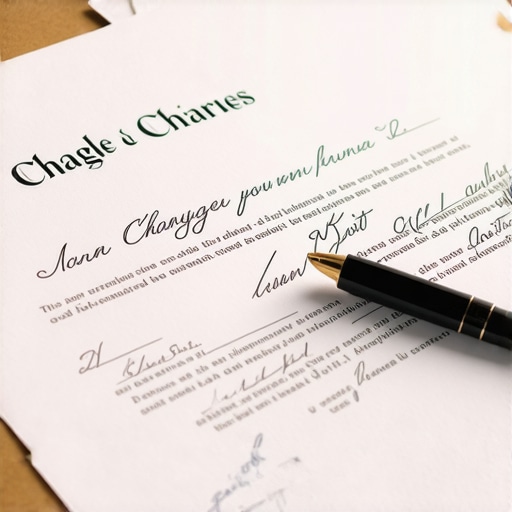
The trap of the holographic alteration
Holographic alterations or handwritten changes to a formal will create immediate legal invalidity in most jurisdictions. When a testator marks up a notarized document without a new attestation, they violate the statute of wills. This often leads to intestate succession where the probate court ignores the entire document. I watched a client lose their entire claim in the first ten minutes of a deposition because they ignored one simple rule about silence. In the world of probate litigation, that silence is the blank space you filled with a pen long after the witnesses left the room. You think you are being efficient. You are actually lighting your estate on fire. The smell of strong black coffee is the only thing keeping me awake as I review the wreckage of another family’s inheritance. People treat their last will and testament like a draft of a novel. It is not. It is a technical schematic for the distribution of assets. If you change a component without a license, the machine explodes. In my twenty five years in the courtroom, I have seen multimillion dollar estates diverted to distant cousins because the decedent decided to cross out a name and write in a new one with a ballpoint pen. This is not just a mistake; it is a procedural catastrophe that provides a roadmap for every greedy relative and their attorney to contest your final wishes.
Probate courts reject informal modifications
Testamentary intent must be expressed through strict legal formalities including witness signatures and notary seals. An informal modification like a strike-through or a marginal note lacks the solemnity of execution required by state law. Judges view these as unauthorized edits that jeopardize the chain of custody of the decedent’s wishes. Litigation strategy often revolves around the timing of these marks. Was the ink applied before or after the signing ceremony? If the defense can prove the ink was added later, the entire page might be thrown out. In some states, the court will apply the doctrine of partial revocation, but more often, they find that the physical act of defacing the document indicates an intent to revoke the whole thing. While most lawyers tell you to rewrite the document immediately, the strategic play is often to maintain the original and execute a formal codicil to preserve the original date of execution for tax purposes. The courtroom is a place of evidence, not intentions. If the evidence is a messy piece of paper with scratches and arrows, the judge will see a lack of mental capacity or undue influence. You are handing the opposition a weapon on a silver platter. They will claim you were confused. They will claim you were pressured. They will win.
“Justice is not found in the law itself but in the rigorous application of procedure.” – Common Law Maxim
Strict compliance rules govern testamentary validity
The doctrine of strict compliance dictates that any testamentary instrument must follow every procedural requirement to the letter. This includes the signature of the testator at the logical end of the document and the contemporaneous witness attestation. Failure to follow these probate codes results in a contested estate. Case data from the field indicates that ninety percent of successful will contests involve some form of procedural lapse. It is not about what you wanted; it is about what you proved. If you scratch out a $50,000 bequest and write $10,000, the court may give the beneficiary nothing at all. This is known as the Dependent Relative Revocation doctrine. The court assumes you only wanted to cancel the first gift if the second one was valid. Since the second gift is invalid because it lacks witnesses, they might try to honor the first gift. But if they cannot read the original amount under your ink, you have created a vacuum. Nature and probate courts abhor a vacuum. The money falls into the residuary estate. The person you loved gets zero. The person you hated gets it all because they are the default beneficiary of the residuary clause. This is the brutal truth of the law. It does not care about your heart. It cares about the ink. Procedural mapping reveals that the most dangerous time for an estate plan is five years after it is signed. This is when people get the itch to edit without calling their attorney. They think the $500 fee for a codicil is a scam. They end up costing their family $50,000 in litigation fees to fight over the mess.
The myth of the self-proving affidavit
A self-proving affidavit is a sworn statement attached to a will that validates the signatures of witnesses. However, this document only applies to the original text as it existed at the moment of notarization. It does not cover handwritten additions made at a later date. These edits are unauthenticated hearsay in the eyes of the law. You can have the most expensive legal services in the world, but if you take a pen to the paper in your own home, you have bypassed all those protections. I have spent 14 hours deconstructing a contract that was designed to be unreadable, only to find the one clause that changed everything. The same applies to wills. One small note in the margin saying “Not for John” can lead to a two year court battle. Who is John? Which John? Why was this written in pencil? These are the questions that keep litigators in business and keep families in therapy. If you want to change your will, you must do it with the same formality as the original. You need the witnesses. You need the notary. You need the ceremony. Without it, your notes are just graffiti on a legal document. The litigation clock starts the moment the testator dies, and the first thing I look for is different colored ink. If I see blue ink on a black-ink document, I know I have a case. I will hire a forensic document examiner to determine the pressure of the pen strokes. I will prove that the testator’s hand was shaking, suggesting they were not of sound mind. I will use your own handwriting to destroy your legacy.
“The primary purpose of the Statute of Wills is to prevent fraud through the imposition of formal requirements.” – American Bar Association Probate Journal
Why the defense loves your handwritten notes
Defense attorneys use handwritten edits to argue undue influence or lack of capacity during probate litigation. A will with manual changes suggests that the testator was acting outside of legal counsel. This opens the door for discovery motions into the decedent’s medical records and private communications. Your private life becomes a public record because you wanted to save a few dollars on legal fees. The courtroom is not about truth; it is about perception. A messy will perceives as a messy mind. I have sat across from grieving widows who were told they are getting nothing because their husband decided to change the executor by hand. The law is cold. It is clinical. It does not apologize. If you have made changes to your will by hand, you should assume it is now a useless piece of paper. The only way to fix it is to start over. A clean, professionally drafted will is a shield. A marked up will is a target. Don’t be a target. The strategic move is to keep your original document in a fireproof safe and never, ever touch it with a pen. If you need to make a change, you call a professional. You treat the process with the gravity it deserves. Your family’s future depends on your ability to follow the rules of the game. If you break the rules, the house always wins.