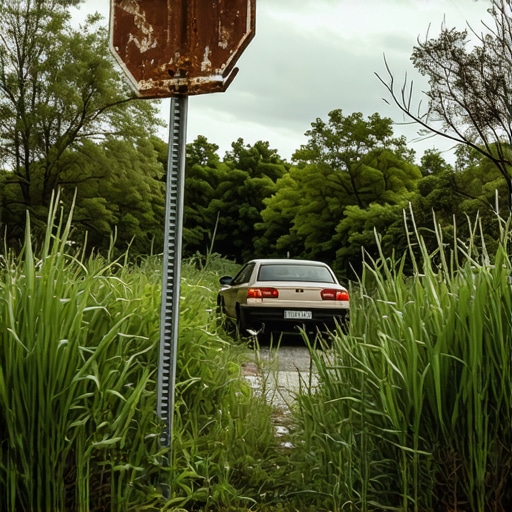
The Litigator’s Approach to Obstructed Traffic Signals
I watched a client lose their entire claim in the first ten minutes of a deposition because they ignored one simple rule about silence. They felt the need to fill the void, explaining away the gaps in their memory of the intersection until they accidentally admitted they were looking at their phone for just a second. That second was the end of a million-dollar case. In the world of litigation, especially when suing a municipality for poor maintenance, your words are either a shield or the blade the defense uses to cut your throat. Proving you did not see a stop sign is not about your feelings; it is about the cold, hard science of sightlines and the paper trail of government neglect.
The myth of the driver’s absolute duty to see
Proving a visibility failure requires establishing that the stop sign was not within the cone of vision as defined by the Manual on Uniform Traffic Control Devices. An attorney must prove the governmental body had actual or constructive notice of the obstruction and failed to act with reasonable diligence. Many legal services fail to highlight that the law does not demand superhuman sight; it demands that signs be placed where they are visible. If a tree branch obscures a sign, the burden of proof shifts toward the maintenance schedule of the city. We look for the breakdown in the system, the ignored work order, or the budget cut that left a dangerous intersection unmanaged. Litigation is the process of exposing these institutional failures.
“Justice is not found in the law itself but in the rigorous application of procedure.” – Common Law Maxim
The forensic architecture of a sightline obstruction
Visibility is a calculated metric involving approach speed, perception-reaction time, and the physical location of the signage relative to the roadway. A litigation expert uses photogrammetry to recreate the driver’s perspective at the exact time of the accident. We do not rely on a cell phone picture taken three days later when the light is different. We analyze the angle of the sun, the specific species of vegetation, and the growth rate of the foliage. In family law, we fight over assets; in traffic litigation, we fight over inches of clearance. If the sign does not meet the height requirements set by federal standards, the city is already at a disadvantage. The defense will claim you should have known the stop sign was there, but the law of negligence focuses on what a reasonable person could see under the specific conditions of that moment.
Why the police report is often a work of fiction
Police reports are frequently inadmissible as evidence because the reporting officer did not witness the event and often relies on hearsay or surface-level observations. A trial attorney must deconstruct the officer’s narrative by highlighting what they failed to investigate. Officers are overworked. They look at the impact, they look at the debris, and they write a ticket. They rarely check if the stop sign has lost its retroreflectivity. If the sign is ten years old and has faded to a dull pink, it might be invisible at night. We use specialized equipment to measure the light return of the sign. If it falls below the minimum levels, the officer’s conclusion that you failed to stop becomes irrelevant. This is where aggressive litigation turns the tide.
Discovery tactics to uncover hidden maintenance logs
The heart of your case lies in the internal emails and maintenance databases of the department of public works. Through the discovery process, an attorney forces the city to reveal every complaint ever made about that specific intersection. If a neighbor called three months ago to report a leaning sign and the city did nothing, that is constructive notice. We look for the gap between the report and the repair. Municipalities often try to hide behind sovereign immunity, but that protection evaporates when there is a known dangerous condition that was ignored. We hunt for the digital footprint of neglect. Every legal service provider knows that a case is won in the dusty files of a government warehouse, not just in the courtroom.
“The right of the people to be secure in their persons and property is often decided by the quality of the record kept by those in power.” – American Bar Association Journal Vol. 82
Challenging the sovereign immunity defense with statutory precision
Sovereign immunity is the primary weapon used by government entities to dismiss your claim before it ever reaches a jury. Overcoming this requires citing specific exceptions within the State Tort Claims Act that waive immunity for highway defects. You are not just suing for a mistake; you are suing for a breach of a non-delegable duty. The state has a duty to maintain safe roads. We argue that an invisible stop sign is not a maintenance failure but a structural defect. This distinction is the difference between a dismissed case and a settlement conference. While a skeptical investor might see the risk as too high, a veteran litigator sees the path through the statutory weeds. We use the law to strip away the government’s armor.
The strategic play of the delayed demand letter
While most lawyers tell you to sue immediately, the strategic play is often the delayed demand letter to let the defendant’s insurance clock run out. This allows for a full investigation into the maintenance history without alerting the city to hide the evidence. We want to know the truth before they have a chance to trim the trees. If you sue too early, the city sends a crew out the next morning to clear the obstruction, and suddenly your photographic evidence is all you have. By waiting, we can observe if the neglect is ongoing. This methodical approach ensures that when we finally strike, the evidence is undeniable. Litigation is not a race; it is an ambush based on superior preparation and forensic detail. [{“@context”:”https://schema.org”,”@type”:”Article”,”headline”:”How to prove you didn’t see the stop sign because of poor maintenance”,”author”:{“@type”:”Person”,”name”:”Senior Trial Attorney”},”description”:”A deep dive into the legal strategies and forensic evidence required to prove municipal negligence in obstructed stop sign cases.”,”articleSection”:”Litigation and Legal Services”}]