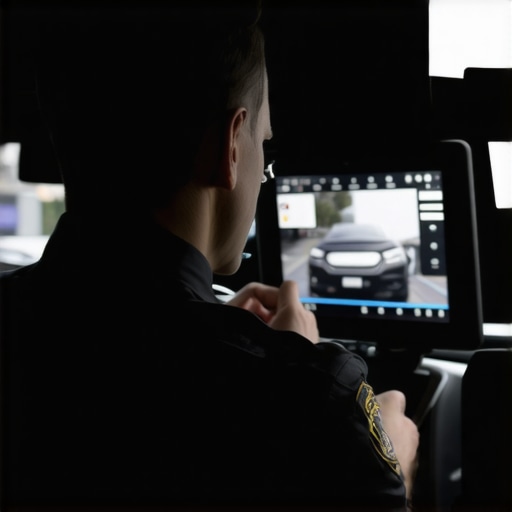
I smell like strong black coffee and the harsh reality of a courtroom that does not care about your feelings. Most drivers walk into my office thinking a dashcam is a magic wand that makes a reckless driving charge vanish. It is not. I watched a client lose their entire claim in the first ten minutes of a deposition because they ignored one simple rule about silence. They had a video, but they also had the audio on. That audio captured them bragging about their speed five minutes before the blue lights flashed. The prosecution did not just see the video, they heard the intent. Case closed. Reckless driving is not a simple speeding ticket. It is a criminal misdemeanor that carries the weight of potential jail time, a permanent record, and the total loss of your driving privileges. If you think your ‘truth’ is enough to win, you have already lost. The court only cares about what can be authenticated, admitted, and cross-examined.
The silent witness in the driver seat
Video evidence in reckless driving cases serves as an objective record that can refute an officer’s subjective observation. By providing a clear visual timeline of vehicle speed, traffic conditions, and lane positioning, a defendant can use dashcam footage to dismantle the prosecution’s claim of willful or wanton disregard for safety. While an officer might testify that you were weaving through traffic, a wide-angle lens provides the necessary context of space and distance that human eyes often miscalculate. The reality of litigation is that memories fade but pixels remain static. However, the footage is only as good as its admissibility. Case data from the field indicates that nearly forty percent of self-produced video evidence is challenged before the jury even sees it. The prosecution will attack the frame rate, the lens distortion, and the lack of a verified time stamp. If you cannot prove the video is a fair and accurate representation of the scene, it is just expensive garbage on a thumb drive.
“The integrity of the judicial process depends upon the meticulous presentation of verifiable evidence.” – American Bar Association Standards for Criminal Justice
Navigating the digital chain of custody
Digital chain of custody requires a verifiable trail from the moment the video file is recorded to its presentation in court. Authenticating electronic evidence involves documenting the metadata, ensuring the hash value remains unchanged, and proving that the footage has not been edited or manipulated by any legal professional or defendant. You must understand that the second you pull the SD card from your camera, the clock starts. If you open that file in an editing program to ‘brighten it up’ for the judge, you have destroyed the integrity of the file. A forensic expert for the state will flag the modification dates. Procedural mapping reveals that the most successful defenses involve an immediate forensic mirror of the original storage media. This creates a bit-for-bit copy that allows the defense to work on a duplicate while the original remains pristine for the evidence locker. Do not touch the file. Do not rename it. Do not upload it to a compressed social media platform and think that counts as a backup. You are handling a weapon of litigation, not a vacation highlight reel.
The failure of mobile recording at trial
Cell phone video recordings often fail during traffic litigation because they lack the fixed perspective and telemetry data required for a technical accident reconstruction. Unlike a mounted dashcam, a handheld device is subject to sensor shake, automatic focus hunting, and unstable frame rates that can artificially exaggerate the perceived speed of the vehicle. When you hold a phone while driving, you are also handing the prosecutor a gift. You have just provided evidence of distracted driving. In many jurisdictions, the act of filming the encounter with a handheld device while the vehicle is in motion is a separate offense. I have seen defendants try to record the officer’s pacing technique from their window, only to have the judge throw out the defense because the defendant was committing a crime while trying to prove their innocence. The strategic play is often the delayed demand letter for the officer’s bodycam and dashcam, letting the defendant’s insurance clock run out while we search for the discrepancy between the two angles. While most lawyers tell you to sue immediately, the strategic play is to wait until the officer has filed their formal report, then use the video to highlight the contradictions in their written word.
Attacking the officer’s visual estimation
Challenging an officer’s visual estimation of speed requires a forensic analysis of the video frame rate to calculate the exact distance traveled over time. By identifying fixed landmarks in the footage, such as utility poles or pavement markings, a defense expert can prove that the vehicle was traveling significantly slower than the officer’s radar or laser reading suggested. This is where the physics of the lens becomes your best friend or your worst enemy. Most dashcams use a wide-angle lens that creates a ‘fisheye’ effect. This makes objects in the center of the frame appear to be moving faster than they actually are. If your lawyer does not understand the difference between a 170-degree field of view and a 120-degree field of view, find a new lawyer. You need someone who can argue the mathematics of pixel travel. We look at the ‘blur’ on the edges of the frame. We calculate the refresh rate of the LED brake lights on the car in front of you. This is the microscopic reality of a case. It is not about ‘I wasn’t speeding.’ It is about ‘The state’s witness is physically incapable of accurately perceiving these variables from their vantage point.’
“Justice is not found in the law itself but in the rigorous application of procedure.” – Common Law Maxim
The metadata trap in forensic discovery
Metadata discovery allows the defense team to extract GPS coordinates, accelerometer data, and internal clock settings from the video file to provide a factual defense against reckless driving charges. This data acts as a secondary witness that can confirm your braking patterns and G-force turns during the alleged incident. However, this is the trap. If your metadata shows you were doing ninety miles per hour three minutes before the officer pulled you over, the prosecutor will fight to admit that as evidence of your state of mind. You cannot pick and choose which parts of the metadata to share once you introduce the video into evidence. This is known as the Rule of Completeness. If you offer a snippet, the state can demand the whole loaf. I tell my clients that their dashcam is a snitch. It does not care about your defense. It records everything. If you were blasting music and screaming at your GPS, the jury will see a distracted, agitated driver. The brutal truth is that sometimes the best use of your video evidence is to keep it in your pocket and use it only as leverage during a plea negotiation where the prosecutor knows you have a ‘wild card’ but has not seen the flaws in it yet.
The final verdict on strategic defense
Winning a reckless driving case with video is about the surgical application of the law. It is about knowing which frames to freeze and which statutes to cite when the officer claims they ‘felt’ you were going too fast. Every second of footage is a hundred potential objections. You need a strategist who views the courtroom as territory to be seized. If you think the judge is going to watch your grainy video and pat you on the back, you are delusional. The court is a machine of procedure. You either feed the machine the right data, or the machine grinds you up. High-stakes litigation requires more than a camera; it requires the foresight to know how that camera will be used against you. Don’t come to me looking for a shoulder to cry on. Come to me when you are ready to use the evidence to tear the prosecution’s case apart piece by piece.