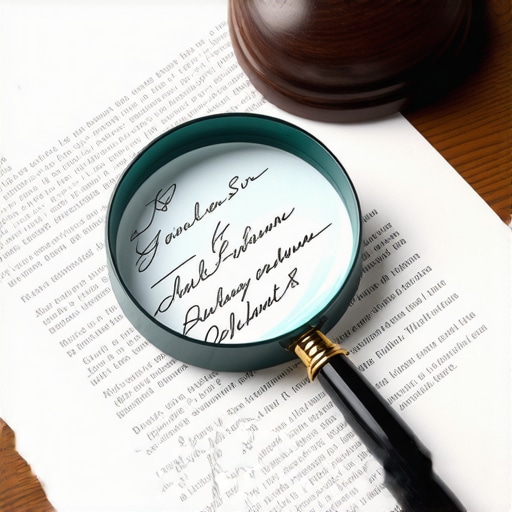
I recently spent 14 hours deconstructing a contract that was designed to be unreadable, only to find the one clause that changed everything. My coffee was cold. My eyes were burning from the fluorescent lights of the records room. But there it was. A signature that looked perfect at a glance but felt dead under the lens. It lacked the natural rhythm of a human hand. It was a mechanical reproduction of a soul, a forgery. Most people think a forgery is a sloppy scribble. It is not. It is often a meticulous, cold-blooded attempt to steal equity, parental rights, or corporate control. You are here because someone lied on paper. I am here to tell you that the truth does not matter if you cannot prove it through the violent machinery of the discovery process.
The forensics of a fake signature
Proving a forged signature requires forensic handwriting analysis to identify microscopic deviations in line quality, pen lifts, and stroke direction. You cannot simply walk into a courtroom and claim that the ink on the page does not belong to you. The court operates on a presumption of validity for signed documents. To break that presumption, we must look at the microscopic reality of the ink. We look for hesitations. A natural signature is a fluid, subconscious motion. A forger is drawing, not writing. This distinction is everything. We look for tremors that occur when a hand slows down to mimic a curve. We look for blunt starts and stops where the pen stayed on the paper too long. If the document is a digital copy, the challenge triples. You need the original wet-ink document. Without it, you are fighting with one hand tied behind your back. Forensic document examiners use electrostatic detection to find indentations from previous pages. They use infrared light to see if two different types of ink were used on the same line. This is not a hobby. It is a forensic war.
“Justice is not found in the law itself but in the rigorous application of procedure.” – Common Law Maxim
Why your claim of forgery often fails in court
Forgery claims fail because plaintiffs lack the evidentiary foundation to overcome the presumption of a validly executed document. Most litigants wait too long to hire an expert. They think their testimony is enough. It is not. If you say it is not your signature and the other side has a notary stamp, the notary wins ninety percent of the time. You must attack the notary. You must subpoena their journals. You must look at the entries immediately before and after the disputed signature. Is the ink the same? Is the chronological order of the logbook intact? If the notary cannot produce their log, you have a path to victory. While most lawyers tell you to sue immediately, the strategic play is often the delayed demand letter to let the defendant’s insurance clock run out or to see if they produce a second, conflicting version of the forged document during pre-litigation posturing. Silence is a weapon. Let them commit to a lie in writing before you show your forensic cards.
The specific role of the forensic document examiner
A forensic document examiner utilizes electrostatic detection apparatus and infrared imaging to reveal the mechanical pressure and ink chemistry of a signature. These professionals are the only voices the judge will respect. They compare the disputed signature against ten to twenty known exemplars. These exemplars must be from the same time period. Your signature today is not your signature from five years ago. We look for the height of the t-crossings. We look at the loop of the ‘g’ or the ‘y’. A forger almost always misses the terminal stroke. That tiny flick of the pen at the end of a name is dictated by the unique muscle memory of your forearm. It is as unique as a fingerprint. In family law litigation, we often see forged signatures on quitclaim deeds used to transfer marital property. The document examiner must be prepared to testify under the Daubert standard. This means their methodology must be peer-reviewed and scientifically valid. If your expert is just a hobbyist, the defense will eat them alive in a deposition.
“The integrity of the legal profession depends upon the authenticity of the records presented to the court.” – American Bar Association Model Rules
How family law litigation handles fraudulent documents
In family law, fraudulent signatures often appear on quitclaim deeds or prenuptial agreements to hide assets or waive rights during a divorce. The emotional stakes in these cases lead people to do stupid things with pens. I have seen spouses forge signatures on tax returns to hide offshore accounts. I have seen them forge consent forms for child passports. The strategy here is not just about the handwriting. It is about the timeline. We map the physical location of the parties on the day the document was allegedly signed. Cell phone tower data. Credit card swipes. If the document was signed in a branch office in Chicago but my client was at a dental appointment in Florida, the signature is irrelevant. The document is dead. Litigation in this area is about logistics. We do not just argue about the ink. We argue about the impossibility of the event. We use the discovery process to lock the opponent into a specific time and place. Once they lie about the location, the forgery becomes a secondary issue to their lack of credibility.
Tactical discovery for proving pen pressure and ink age
Discovery in forgery cases must include the original physical document to allow for destructive or non-destructive chemical testing of the ink. If you are working with a PDF, you are losing. You need to see the fibers of the paper. A forensic examiner can determine if a signature was printed by a high-end laser printer rather than a ballpoint pen. This is called a ‘flat’ signature. It lacks the three-dimensional troughs created by a pen nib. We also look for ‘bridge’ strokes. This is where a forger connects letters that you normally keep separate. Your legal services provider must be aggressive in filing motions to compel the production of the original. If the opposing party claims they lost the original, we move for an adverse inference instruction. We ask the judge to tell the jury that the document was lost because it would have proven the forgery. That is how you win. You do not wait for a confession. You build a cage of procedural failures around the opponent until they have no room left to breathe.
The standard of proof for fraud in contract disputes
Proving forgery generally requires clear and convincing evidence, which is a higher bar than the standard preponderance of the evidence. This is the cliff where most cases die. You are not just proving a mistake. You are proving an intentional act of deception. The court requires a high level of certainty. This is why the expert report must be flawless. It must be a narrative of mechanical impossibility. We use high-resolution photography to show the jury the ‘start-stop’ marks of the forger. We show them the ‘hesitation’ bloat where the ink pooled while the forger was thinking about the next curve. We make the jury feel the deception. Case data from the field indicates that juries respond more to visual overlays than to verbal testimony. We overlay a known signature over the forged one. If they are an exact match, it is a forgery. No human signs their name exactly the same way twice. An exact match is a trace. A trace is a lie. Your litigation strategy must be built on these microscopic truths. Leave the grand speeches to the television lawyers. We win in the weeds of the evidence.