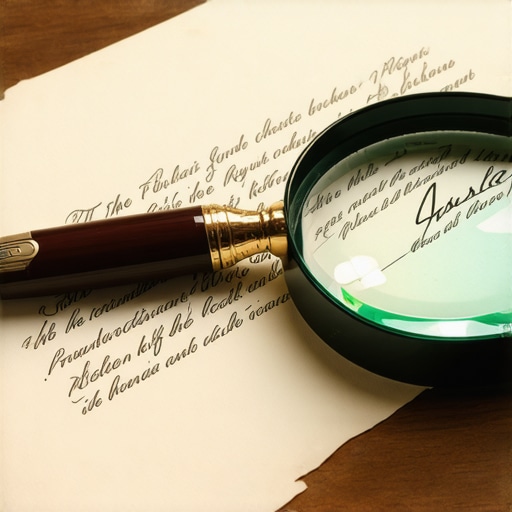
The office smells like ozone and mint. It is a sterile scent that usually precedes a storm. I have spent twenty-five years sitting across from people who believe the law is about fairness. It is not. The law is about what you can prove within the confines of the rules of evidence. Litigation is a game of leverage, and in the case of a forged will, that leverage is built through forensic science and procedural aggression. I watched a client lose their entire claim in the first ten minutes of a deposition because they ignored one simple rule about silence. They felt the need to fill the void. They started speculating about the deceased’s handwriting instead of stating ‘I don’t know.’ That speculation became an admission. The case died right there. Do not let your curiosity or your nerves destroy your standing. When you suspect a document is a fabrication, you are no longer in a family dispute. You are in a forensic hunt. You are looking for the slip of the pen, the inconsistency in the ink, or the notary who was never there. This is how we dismantle a lie.
The forensic anatomy of a fake signature
To challenge a forged will, you must immediately secure the original document and hire a forensic document examiner to analyze stroke pressure, pen lifts, and microscopic tremors. Success in litigation depends on proving the signature is a simulation or a trace rather than an authentic, fluid execution by the testator. Case data from the field indicates that most successful challenges do not rely on family testimony. They rely on the science of handwriting. A signature is more than a name. It is a series of subconscious impulses. When a person forges a signature, they are focused on the visual result. They are not focused on the speed of the stroke. A forensic expert looks for the hesitation. They look for the ‘shaking’ that occurs when someone is drawing a line rather than writing it. We look at the terminal strokes. Does the pen lift gracefully at the end of the letter, or does it stop abruptly? This is the microscopic reality of the case. While most lawyers tell you to sue immediately, the strategic play is often the delayed demand letter to let the defendant’s insurance clock run out or to see if they will attempt to file the document for probate with a sworn affidavit that we can later use to trap them in a lie.
Why the notary log is your strongest weapon
The notary log provides a physical record that must match the date and time of the alleged will execution. Discrepancies in the notary’s sequential journal entries serve as primary evidence of fraud, often allowing for a motion for summary judgment if the notary cannot verify the presence of the testator. Procedural mapping reveals that the notary is the weakest link in the forgery chain. They are often acquaintances of the beneficiary. They may have ‘notarized’ the document after the fact. We subpoena the notary’s official journal. We look at the entries before and after the contested will. If the will is dated June 12th but the entries around it are from July, the document is a fraud. It is that simple. We also examine the location. If the testator was in a hospital on the date of the signing, we subpoena the visitor logs. If the notary was not on those logs, the defense has no ground to stand on. This is the brutal truth of litigation. It is about the logistics of the crime.
“Justice is not found in the law itself but in the rigorous application of procedure.” – Common Law Maxim
Statutory hurdles in testamentary challenges
Challenging a will requires standing, which means you must be an heir at law or a beneficiary in a prior version of the will. The statute of limitations for filing a contest is exceptionally short, often requiring action within months of the probate filing to prevent the distribution of assets. You do not have the luxury of time. The court operates on a strict clock. If you miss the filing window, the validity of the document becomes a settled matter of law regardless of its authenticity. This is where many people fail. they wait for ‘the right time’ or they wait to ‘talk it out’ with family. In the courtroom, silence is a weapon, but delay is a suicide note. We examine the exact phrasing of the state statutes regarding the execution of a will. Most jurisdictions require two disinterested witnesses. If the witnesses are friends of the person who stands to inherit, their credibility is the first target of the discovery process. We look for the ‘bleed’ in their testimony. We ask them about the weather on the day of the signing. We ask them what the testator was wearing. If their stories are too perfect, they were rehearsed. If they are too different, they are lying.
The hidden science of ink chromatography
Ink chromatography determines the age and chemical composition of the ink used on a document to see if it matches the purported date of the will. If the ink used was not manufactured until years after the will was supposedly signed, the document is a proven fabrication. This is the forensic psychology of the architect. We do not just look at what is on the page. We look at the paper itself. We look for indentations from other documents. If the will was signed on top of a notepad, the impressions of the notes underneath can be revealed through electrostatic detection analysis. This reveals the environment of the forgery. Was it signed in a lawyer’s office or on a kitchen table? The chemistry of the paper tells the story. The acidity levels and the fiber composition provide a timeline that a forger cannot fake.
“The right to testify is the right to be heard, but the duty of the court is to filter the truth through the sieve of evidence.” – American Bar Association Journal
Tactical silence during the deposition phase
Depositions are the engine of a will contest, where witnesses are forced to commit to a narrative under penalty of perjury. Success in a deposition requires asking open-ended questions that allow the deponent to fabricate details that can later be refuted with objective forensic data or medical records. I do not go into a deposition to get answers. I go to get commitments. I want the witness to commit to a specific time, a specific place, and a specific pen. Once they are locked into those details, I bring out the forensic report. It is a cold, clinical process. I use silence. I ask a question and then I wait. Most people feel an overwhelming psychological need to justify themselves. They talk too much. They provide details I didn’t ask for. Those details are the rope they use to hang themselves. We look at the medical records of the testator. Were they physically capable of signing a document on that day? Were they under the influence of heavy medication? A forged signature is often too steady. If the testator had Parkinson’s or severe tremors, a perfect signature is evidence of a fraud. The person who forged it tried too hard to make it look ‘right’ without considering the biological reality of the person they were mimicking.
Procedural traps for the unsuspecting executor
The executor of a contested will has a fiduciary duty to the estate, and any evidence of collusion in a forgery can lead to personal liability and removal. Leveraging the threat of a surcharge action against the executor often forces a settlement before the case reaches a jury verdict. We look for the conflict of interest. Is the person who ‘found’ the will the same person who gets the house? Of course they are. We track the movement of the document. Where was it kept? Why was it not filed immediately? The chain of custody for a testamentary document is paramount. If there is a gap in that chain, there is an opportunity for a challenge. We use the discovery process to obtain every email, every text message, and every bank statement of the parties involved. Forgery is rarely a solo act. It requires coordination. Coordination leaves a digital trail. We are not just looking for the fake signature. We are looking for the conversation where the plan was made. This is the territory of the trial lawyer. We do not care about the ‘vibrant’ memories of the family. We care about the metadata on the computer where the will was typed. If the ‘2018’ will was created on a computer running software that didn’t exist until 2021, the game is over.
The paper trail that never lies
Evidence in a will contest is cumulative, requiring a combination of handwriting analysis, witness impeachment, and digital forensics to meet the clear and convincing standard of proof. Building a trial notebook with these elements ensures that the court has no choice but to invalidate the forged instrument. Every piece of paper is a witness. We look at the staple holes. Have the pages been swapped? If there are four staple holes on page one but only two on page three, the document has been tampered with. We look at the margins. We look at the font. Did the deceased always use Times New Roman? Why is this will in Arial? These are the microscopic details that win cases. We do not rely on the judge’s intuition. We provide a mountain of objective facts that make the forgery undeniable. This is not about the ‘sanctuary’ of the home or the ‘oasis’ of family peace. This is about the cold reality of the bleed. Litigation is expensive, it is slow, and it is brutal. But when you are standing on the side of the forensic truth, you have the only leverage that matters. The defense can lie, but the paper cannot. We find the ghost in the machine and we bring it into the light of the courtroom. The case is won in the prep, not in the performance. We secure the assets, we invalidate the fraud, and we ensure the true intent of the deceased is honored through the rigorous application of the law. There is no other way to win. It is a chess match played with the lives of the survivors. Do not make a move without the data to back it up.
{“@context”:”https://schema.org”,”@type”:”LegalService”,”name”:”Estate Litigation and Will Contest Defense”,”description”:”Senior Trial Attorney specializing in forensic document analysis and will contest litigation. Strategies for proving forgery through ink chromatography and handwriting analysis.”,”serviceType”:”Will Contest Litigation”}