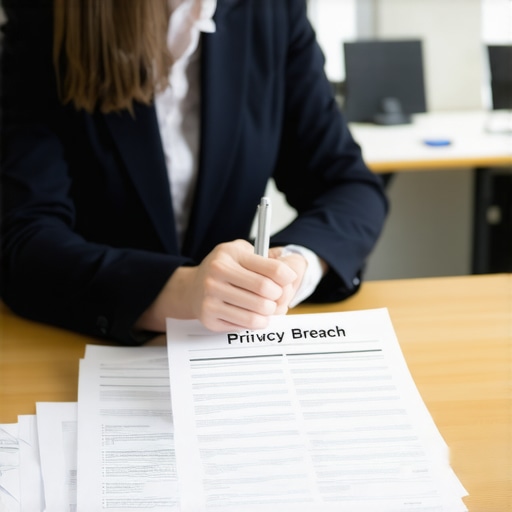
The brutal truth about medical privacy litigation
You think you have a case because your doctor’s receptionist whispered your diagnosis to a neighbor? You do not. Not yet. I recently spent 14 hours deconstructing a contract that was designed to be unreadable, only to find the one clause that changed everything. Most plaintiffs walk into my office smelling of hope, but they leave smelling of the cold reality that the law is a machine of procedure, not a fountain of justice. HIPAA is a federal regulatory framework, not a direct ticket to a settlement. To win, you must navigate a maze of state statutes and forensic evidence that most firms are too lazy to touch. I have seen countless claims die because the attorney did not understand the difference between a regulatory violation and a compensable tort. If you want to hold a covered entity accountable, you need to stop thinking about privacy and start thinking about liability, negligence, and the forensic trail of your digital medical records.
The fine print nightmare behind medical data
HIPAA violations rarely lead to direct payouts because the Health Insurance Portability and Accountability Act lacks a private right of action. This means an individual plaintiff cannot sue a covered entity directly for federal law violations. Instead, a legal strategist must look for state tort claims or breach of contract theories. Case data from the field indicates that the federal government is the only entity that can technically enforce HIPAA through the Office for Civil Rights. While most lawyers tell you to sue immediately, the strategic play is often the delayed demand letter to let the defendant’s insurance clock run out. This allows the internal audit logs of the hospital or clinic to become static, preventing them from being scrubbed under the guise of routine maintenance. I have sat through depositions where the defense attorney tried to hide behind the lack of a private right of action, only to be hit with a state-level negligence claim that used HIPAA as the standard of care. This is the chess game of modern litigation. You do not attack the front door; you find the side entrance left open by poor cybersecurity training or negligent staff behavior. Every medical facility has a weak link, usually a middle manager who thinks BCC on an email is optional.
“Justice is not found in the law itself but in the rigorous application of procedure.” – Common Law Maxim
The lack of a private right of action
Federal courts consistently rule that HIPAA does not grant individuals the right to file a lawsuit. Only the Office for Civil Rights (OCR) or State Attorneys General can levy civil monetary penalties. To seek damages, your litigation team must pivot to breach of contract or negligence as the primary cause. Procedural mapping reveals that attempting to cite HIPAA as the sole cause of action in a federal filing will result in a swift motion to dismiss. I have watched junior attorneys make this mistake, thinking they can ride the coattails of federal law into a high-value settlement. It never works. The court sees the lack of statutory standing and closes the door before you can even present evidence of the breach. The real work happens in the trenches of state law, where we use the federal standards as a yardstick. If the hospital failed to meet HIPAA standards, they have breached the industry standard of care. That is the opening we need for a negligence claim. We are not suing for a HIPAA violation; we are suing for the failure to act as a reasonable healthcare provider in the digital age. It is a subtle distinction that makes the difference between a dismissed case and a six-figure verdict.
The strategic leverage of state tort law
State privacy laws provide the actual foundation for most medical privacy litigation. By alleging invasion of privacy, negligence per se, or intentional infliction of emotional distress, an attorney can use the HIPAA standards as the benchmark for a duty of care breach within state courts. Information gain in these cases often comes from identifying specific state statutes that mirror federal privacy protections but offer a private remedy. In states like California or Massachusetts, the statutory landscape is much more favorable for the plaintiff. In other jurisdictions, you are fighting an uphill battle against antiquated common law. You must look at the exact phrasing of the state’s consumer protection acts. Often, a medical privacy breach is also a deceptive trade practice. If a hospital advertises “secure patient portals” and then leaks your data through a misconfigured SQL database, they have lied to the consumer. This brings in a whole new set of statutory damages and attorney fee provisions. The goal is to stack as many viable state-level claims as possible to survive the inevitable motion for summary judgment. I look for the cracks in their digital walls, the unencrypted laptops, and the thumb drives left in coffee shops. That is where the evidence lives.
Why your attorney looks for the negligence claim
Negligence claims succeed when a lawyer proves a healthcare provider failed to maintain reasonable security measures. If a breach of duty caused actual harm, such as identity theft or reputational damage, the litigation can move toward a jury trial or settlement negotiations. The smell of strong black coffee often accompanies the late-night review of these claims. We are looking for the ‘but-for’ causation. But for the hospital’s failure to update their server software, your psychiatric records would not be on the dark web. It sounds simple, but the defense will argue that the breach was the result of a sophisticated state-sponsored cyberattack that no amount of care could have prevented. We counter this by showing they ignored basic security patches for six months. This is where the litigation architect wins or loses. You must be more technically proficient than the IT director you are deposing. You need to know the difference between AES-256 encryption and a simple password protected file. If you cannot speak the language of the breach, you cannot prove the negligence. The jury needs to understand that this was not a sophisticated heist; it was the digital equivalent of leaving the pharmacy back door unlocked in a bad neighborhood.
“The expectation of privacy in one’s medical records is a fundamental right that requires aggressive protection through civil litigation.” – American Bar Association Journal
The high cost of discovery in privacy litigation
Electronic discovery or e-discovery in privacy breach cases involves forensic audits of server logs and access metadata. A senior trial attorney will subpoena audit trails to prove who viewed the protected health information (PHI) and when the security incident occurred. This is the most expensive and grueling part of the case. We are talking about terabytes of data. I have spent weeks with forensic experts, looking at the exact millisecond an unauthorized IP address from an overseas server touched a client’s records. The defense will bury you in useless documents, a tactic known as the ‘document dump,’ hoping you won’t find the smoking gun. You have to be relentless. You look for the gaps in the logs. Why is there no record of access for the Tuesday between 2 AM and 4 AM? That is usually where the breach happened. If the logs are missing, we move for an adverse inference instruction based on the spoliation of evidence. If they cannot produce the logs they are required by law to keep, the court can tell the jury to assume the logs contained evidence of negligence. That is how you turn a technical failure into a tactical victory.
How family law cases weaponize medical records
Family law proceedings often involve the illegal leak of medical records to influence custody battles or alimony. When an attorney accesses sensitive data without a valid subpoena or HIPAA-compliant authorization, they expose their client and themselves to significant legal liability and sanctions. I have seen divorce cases turn into privacy nightmares because one spouse used their position as a healthcare worker to snoops into the other’s records. This is a clear violation of both professional ethics and privacy law. In these instances, the litigation is not just about the breach; it is about the weaponization of private information. We immediately move for an injunction and a protective order. We then file a separate civil suit for the invasion of privacy. The family law judge will not be happy, and the opposing counsel will find themselves at the wrong end of a bar grievance. Privacy is the ultimate leverage in domestic litigation, and when it is violated, the gloves come off. You don’t just sue the spouse; you sue the medical facility that allowed the unauthorized access. They are the ones with the deep pockets and the insurance policies that cover professional negligence.
The tactical timing of your demand letter
Demand letters should be sent only after the statute of limitations is mapped and the defendant’s insurance policy is identified. By delaying the formal notice, a litigator allows the covered entity to make admissions during internal investigations that can be captured through pre-litigation communication. Most people want to fire off a letter the moment they find out their data was breached. That is a mistake. You want to wait until you have gathered as much external evidence as possible. You want to see if the Office for Civil Rights opens an investigation. You want to see if other victims come forward. The goal is to present a demand that is so well-documented and so grounded in state law that the insurance adjuster realizes that going to trial will cost them five times the settlement amount. We don’t just ask for money; we present a narrative of systemic failure. We show them the deposition of their own security officer from a similar case three years ago. We show them that we know their secrets. This is not a request; it is a calculation of their financial risk. If they are smart, they pay. If they are arrogant, we go to court.
Evidence preservation in the digital era
Spoliation of evidence occurs when a hospital or clinic deletes access logs after a privacy breach. A litigation hold notice must be served immediately to ensure that metadata and backup tapes are preserved for forensic analysis during the discovery phase of the lawsuit. The moment you suspect a breach, you must act. If you wait six months, those logs are overwritten. The hospital’s IT department is not your friend; their job is to clear space on the server and minimize the footprint of any incident. My first move in any privacy case is to send a 10-page preservation letter that names every possible storage device, cloud server, and local workstation. I want them to know that if a single byte of data goes missing, I will be asking for sanctions. We use forensic psychology to anticipate where they will hide the data. Usually, it is on an off-site backup or in a ‘shadow IT’ system that the management doesn’t even know exists. We find the person who actually manages the servers, not the executive who signs the checks. That is where the truth is buried.
The verdict on your privacy claim value
Settlement values for medical privacy breaches vary based on the severity of the leak and the intent of the defendant. While many cases settle for the cost of credit monitoring, cases involving malicious intent or public disclosure of private facts can reach six-figure verdicts. Do not let anyone tell you that your privacy is worthless. The value of the case is tied to the sensitivity of the data. A breach of your blood pressure readings is one thing; a breach of your psychiatric history, your HIV status, or your reproductive health records is entirely different. We quantify the damage by looking at the impact on your life. Have you lost a job? Has your reputation been destroyed? Are you suffering from clinical anxiety? We bring in expert witnesses to testify about the long-term effects of identity theft and the permanent nature of data on the internet. Once your medical history is leaked, it can never be fully retracted. It is a permanent stain on your digital life. We hold the negligent parties responsible for every cent of that damage. The courtroom is the only place where the little guy can force a multi-billion dollar healthcare conglomerate to pay for its laziness. It is not a quick process, and it is not for the faint of heart, but it is the only way to ensure it doesn’t happen to the next person.