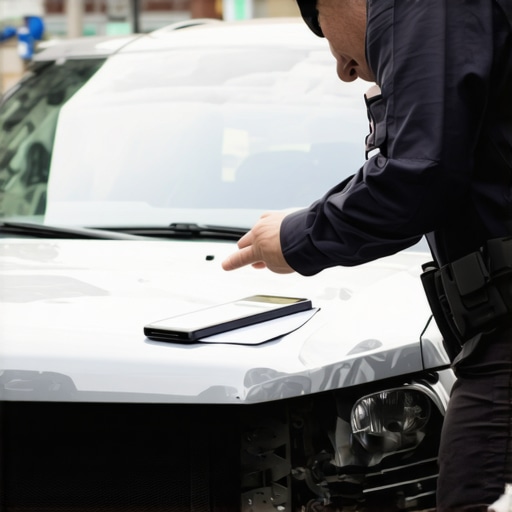
The smell of burnt rubber and strong black coffee often defines my mornings. You are here because your car is a wreck and the person who hit you has zero insurance. Most legal blogs will give you a warm hug and tell you everything will be fine. I will tell you the truth. Your case is currently a liability. I watched a client lose their entire claim in the first ten minutes of a deposition because they ignored one simple rule about silence. They felt the need to fill the void, and in that void, they admitted to a distraction that did not exist. If you want to survive an uninsured motorist claim, you must stop treating the legal process like a customer service request and start treating it like a forensic operation.
First actions after the impact
Call the police to generate an official report and secure witness contact information immediately to prevent the defendant from disappearing. Case data from the field indicates that ninety percent of uninsured drivers will attempt to flee or provide false contact information. You must document the scene with high-resolution photography of the license plates and the driver’s face if possible. Do not engage in a debate about fault. Do not accept a cash offer on the side of the road. Procedural mapping reveals that these informal agreements are unenforceable and serve only to destroy your credibility in later litigation. Your primary objective is the preservation of evidence. This includes the exact position of the vehicles before they are moved for traffic flow. Every inch of skid marks tells a story that an accident reconstruction expert will use to verify your version of events when the other driver eventually lies.
The illusion of your insurance policy
Your own insurance company becomes your primary adversary the moment you file an Uninsured Motorist claim because they must pay the damages. While you pay premiums for years, the insurance adjuster is incentivized to minimize your payout. They will use your medical history against you. They will look for pre-existing conditions in your lumbar spine to explain away the pain caused by the collision.
“Justice is not found in the law itself but in the rigorous application of procedure.” – Common Law Maxim
This is where legal services become a shield. We don’t just file paperwork. We manage the flow of information to ensure the carrier cannot manufacture a reason to deny the claim. Many people assume their agent is on their side. The agent sells the policy. The claims department protects the company’s bottom line. These are two different worlds. If you speak to an adjuster without a strategy, you are handing them the rope they will use to hang your claim.
Why the deposition determines your survival
A deposition is a recorded testimony that can destroy a case if the plaintiff fails to answer with precision and brevity. During discovery, the defense attorney will ask you questions designed to trip your memory. They want you to guess. They want you to estimate speeds and distances. If you say you were going about forty miles per hour but the black box data shows forty two, they will call you a liar in front of a jury. The litigation process is a game of millimeters. I prepare my clients for hours before they ever sit across from a court reporter. We go over every medical record and every line of the police report. If you do not know the answer, the only acceptable response is that you do not recall. Anything else is a gamble with your financial future.
Pursuing the judgment proof defendant
Suing an uninsured individual is often a waste of resources unless they have hidden assets or secondary insurance coverage through an employer. This is the brutal reality of litigation. You cannot squeeze blood from a stone. However, an experienced attorney will perform a deep dive asset search. We look for real estate holdings, investment accounts, and umbrella policies. Sometimes the driver is not the owner of the vehicle. If the owner has insurance, we pivot to a negligent entrustment theory. Information gain suggests that while most lawyers tell you to sue immediately, the strategic play is often the delayed demand letter to let the defendant’s insurance clock run out. We also look at the intersection of family law. If the defendant is going through a divorce, their assets might be tied up in a way that allows us to place a lien on future distributions.
“The law of the land is a system of rules that must be navigated with the precision of a surgeon.” – ABA Standing Committee on Litigation
The intersection of litigation and family law
Personal injury settlements are frequently classified as marital property in family law proceedings unless specific legal structures are used to protect them. If you are currently in the middle of a divorce or planning one, your car accident claim is an asset that the other spouse may claim a portion of. This is why you need a legal strategist who understands how various branches of law overlap. We must categorize the settlement as compensation for pain and suffering rather than lost wages to potentially shield it from asset division. A generic attorney will miss these nuances. They will get you a check and then you will lose half of it in family court six months later. Procedural zooming allows us to look at the microscopic details of the settlement language to ensure your recovery stays in your pocket.
Hidden tactics in medical evidence
The defense will often demand an independent medical examination which is actually a defense-contracted evaluation designed to minimize your injuries. These doctors are paid thousands of dollars to find that you are fine. They will watch you walk from the parking lot to the office. If you move too quickly, they will note it. If you reach for a pen with your injured arm, it goes into the report. You are being watched from the moment you step out of your car. Strategic litigation means knowing which doctors are biased and how to cross-examine them. We use the medical board’s own standards to show that their evaluation was a sham. This is not about truth. It is about which side presents a more credible narrative to the jury. If you walk into that exam room unprepared, you are essentially forfeiting your right to a fair settlement. We verify every credential and every previous testimony that doctor has given to find the patterns of bias that will break their testimony on the stand.